The Return of Ancient Spiritual Technology
2026-10-21
How SriYantra.app turns a thousand-year-old map of the mind into a personal 3D meditation, and why creators who care about these traditions are being invited to share it.
Long before brain scanners, wearables and meditation apps, people were building tools for the mind.
Shamanic cultures used rhythm, ritual and night-long ceremony to shift perception. Yogic traditions mapped the breath, attention and the body with remarkable precision. Tantric traditions went further still: they drew the inner life as geometry, and used sound, gesture and visualisation to move through it.
None of these were technologies in the electronic sense. But they shared something essential with technology. They were structured methods, refined over generations, designed to produce a particular change in the person using them.
Today a new generation of makers is going back to those methods, not to replace them, but to make them reachable again. One of the most beautiful examples is SriYantra.app, a project that turns the Sri Yantra into a personal, guided 3D meditation for the moments that keep replaying in our heads.
The Sri Yantra: an ancient map of the mind
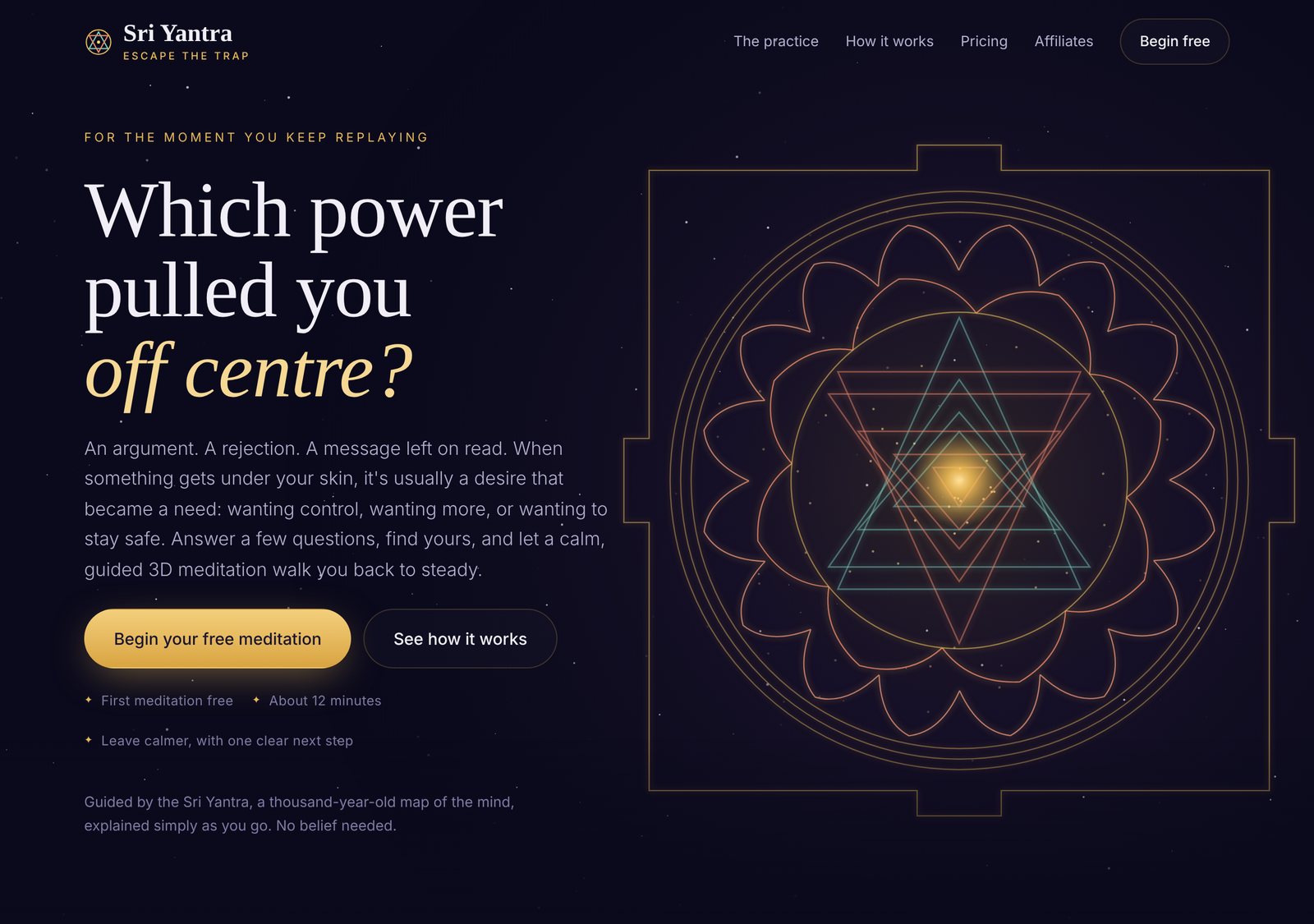
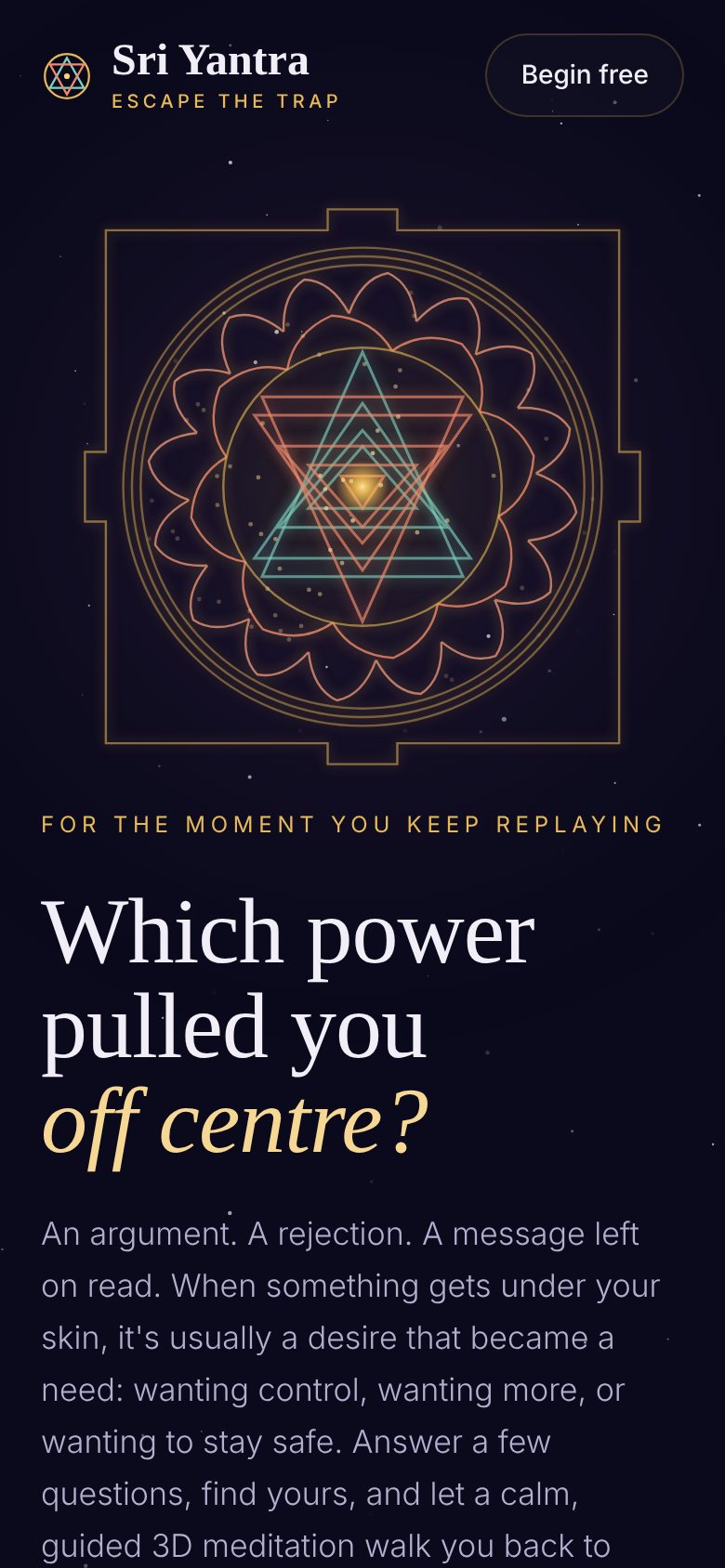
The Sri Yantra, also called the Sri Chakra, is the central sacred diagram of the Sri Vidya tradition of Shakta Tantra. Nine interlocking triangles sit inside rings of lotus petals, all held within a square with a gate on each side.
Its nine enclosures, the avaranas, run like rooms inside rooms: from the outer square, where we meet the world, inwards to a single point at the centre, the bindu. Each enclosure is populated by forces, qualities and practices. Traditionally the journey was taught slowly, by a teacher, over years.
Read with a modern eye, the yantra is less a picture than a sequence. It shows how something that happens to us passes through layers (what we feel, the power we reach for, the belief underneath) and how attention can travel back through those layers to a place where nothing is missing.
That raises a question for anyone building with technology today: can an interactive experience make this map usable again, for people who have never heard of it?
Inside SriYantra.app: a meditation made for your moment
Most meditation apps hand you a library. SriYantra.app starts somewhere more personal: with something that actually happened to you.
Its premise is simple and quietly radical. When something gets under your skin (an argument, a rejection, a message left on read), it is usually a desire that became a need: wanting control, wanting more, or wanting to stay safe. The yantra shows you which one, then walks you back to steady.
A session takes about twelve minutes, in five steps.
1. Tell it. You describe the moment in your own words: what happened, how you felt, what you thought, what you did. If something is unclear, the app asks one or two gentle questions first.
2. See the pattern. You enter a 3D Sri Yantra through one of its four gates, and meet the power you gripped in that moment.
3. Feel it. A quality to call on, an open prayer written for your situation, and hand gestures (mudras) held at the heart.
4. Rest. You climb the terraces to the golden point at the centre, where nothing is missing.
5. Return free. You leave through the same gate with one small, concrete action for real life.
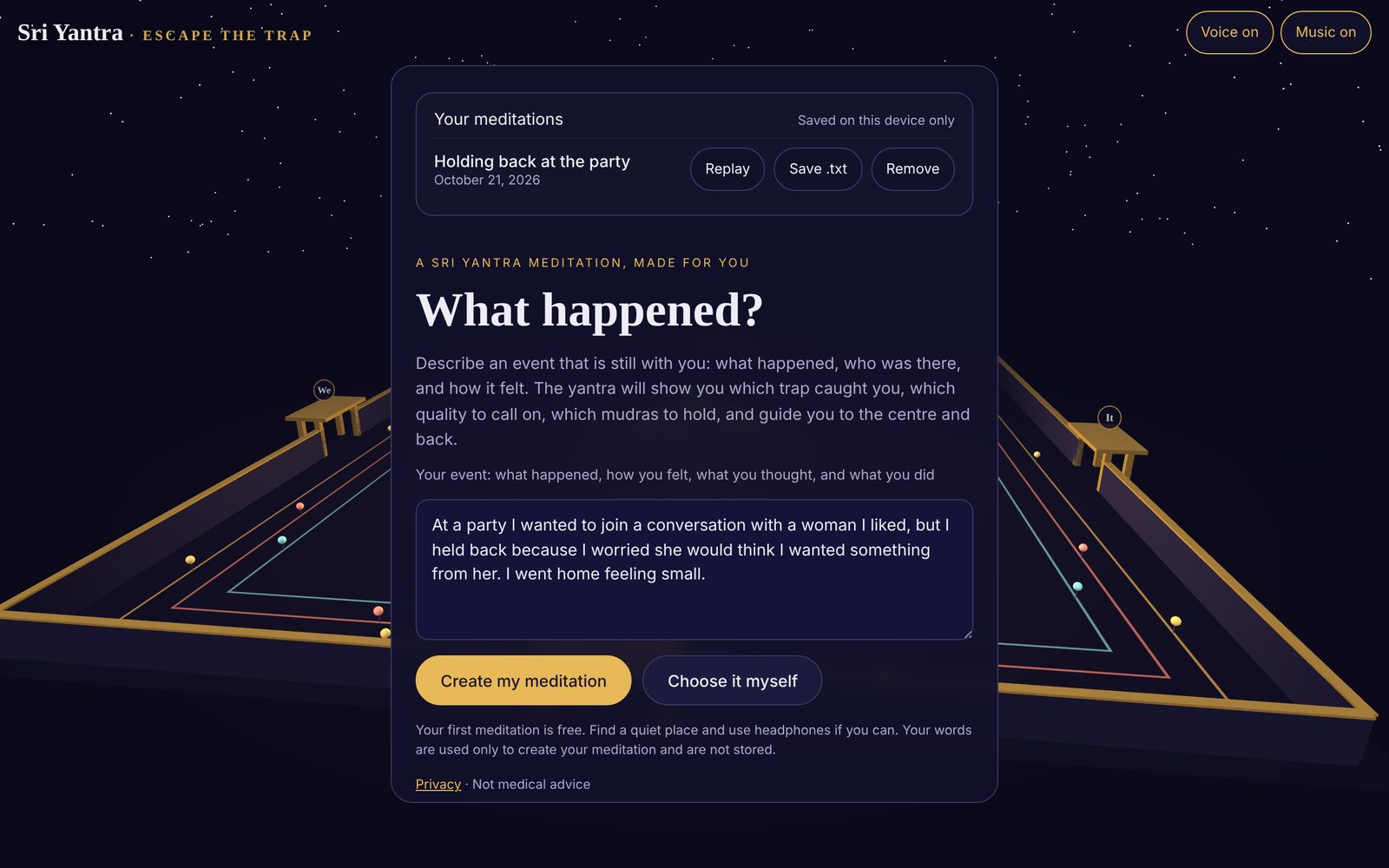
A calm, slow female voice guides each step over a soft musical drone. Every word also appears on screen, so it works with or without headphones.
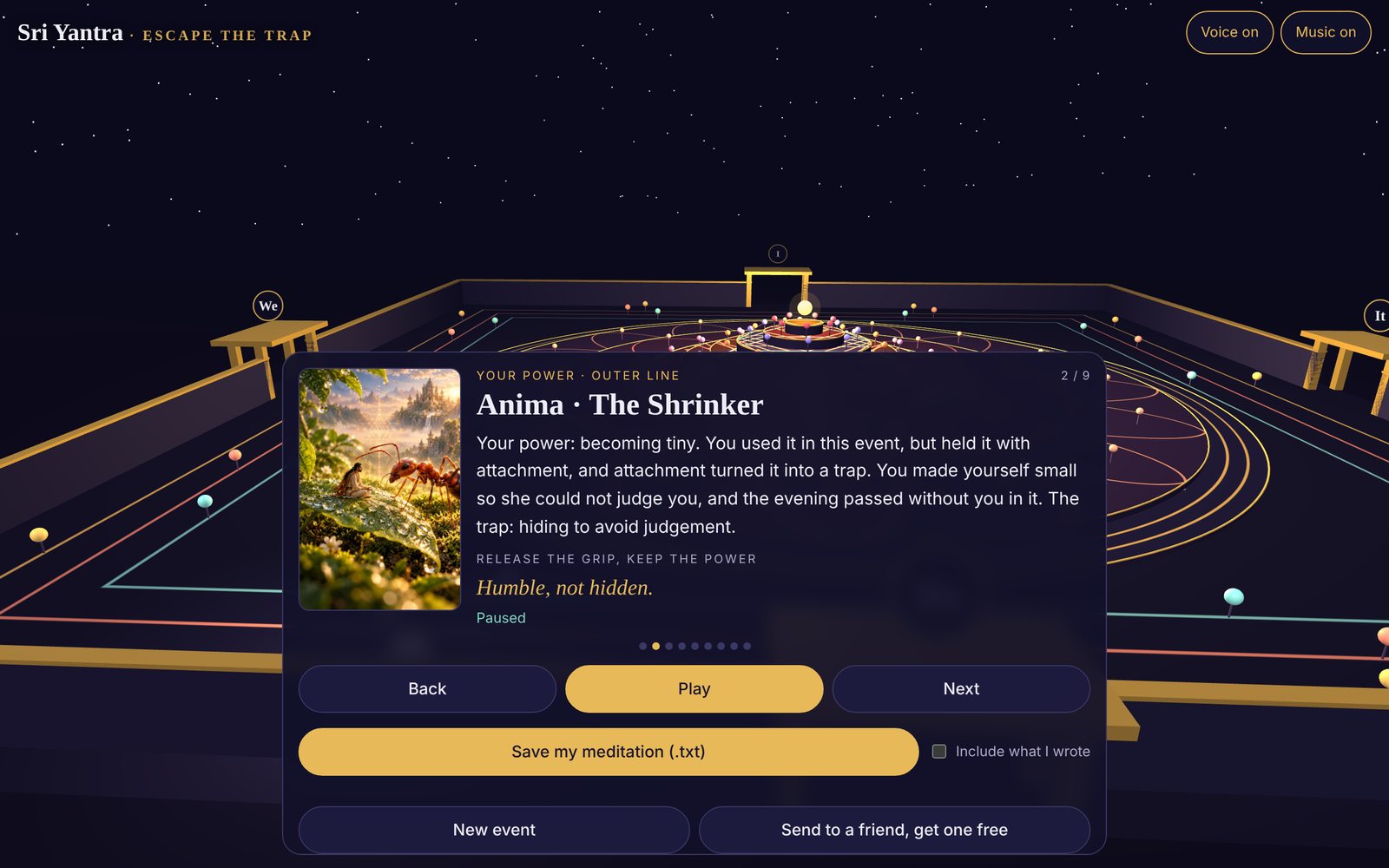
The language is deliberately open. Prayers are written as intentions ("May its energy become creation. May I feel it fully, and stay free.") and never name a god, so the practice suits any belief, or none.
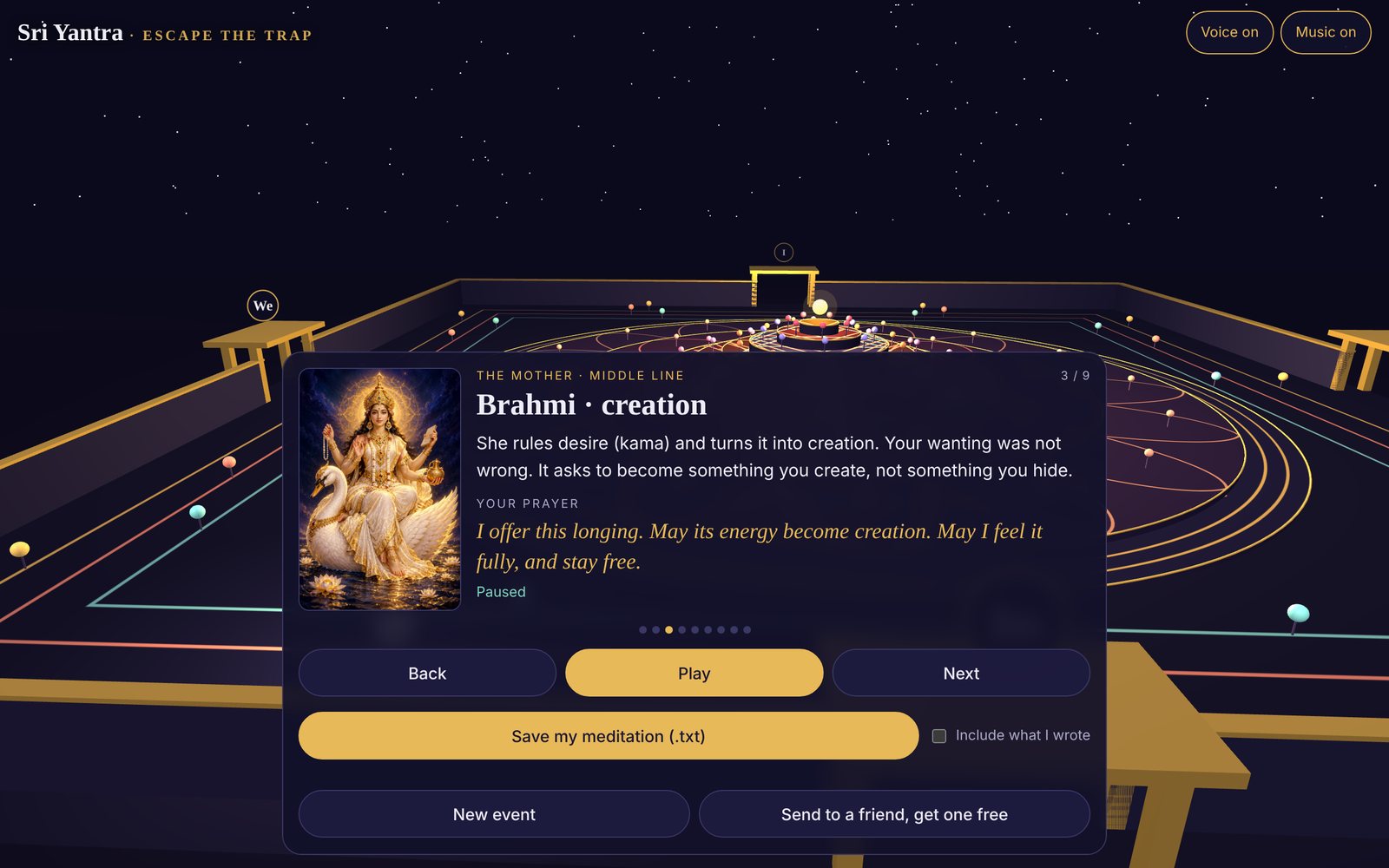
At the end you can save the whole meditation as a text file: the spoken guidance word for word, your personal reading, your prayer and your one free action. Past meditations stay on your device to replay. What you write is used only to create your meditation and is not stored on the app's servers.
Ten powers, eight mothers, and the hands
The app keeps the yantra's real structure, layer by layer, and translates each layer into something a person can feel.
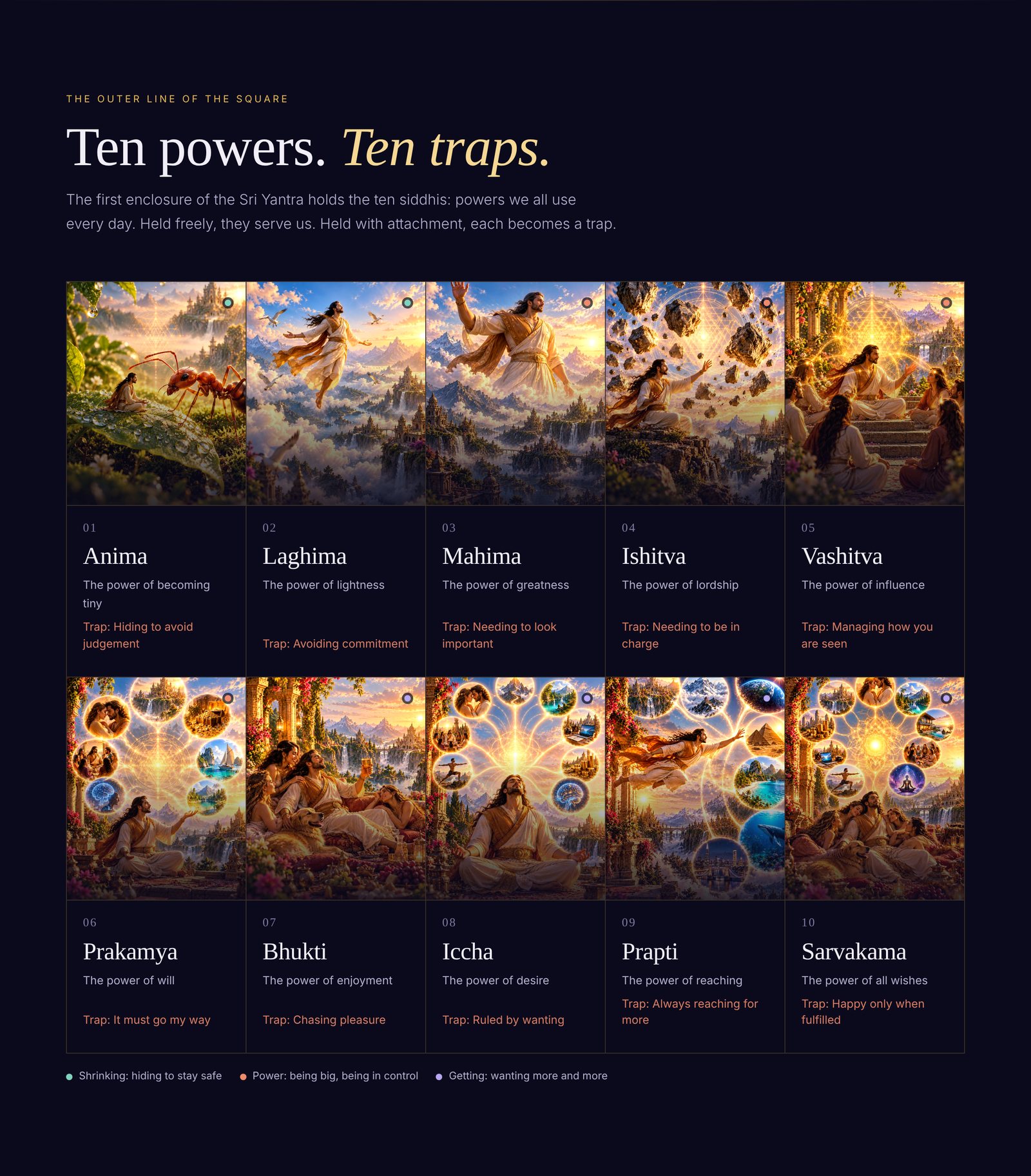
The ten powers. The outer square of the Sri Yantra holds the ten siddhis, classically described as extraordinary powers: becoming tiny, becoming weightless, becoming vast. SriYantra.app reads them as powers we all use every day. Making ourselves small, keeping things light, being in charge, managing how we are seen. Held freely, they serve us. Held with attachment, each becomes a trap. The app's central line is: the power is not the problem; the grip is.
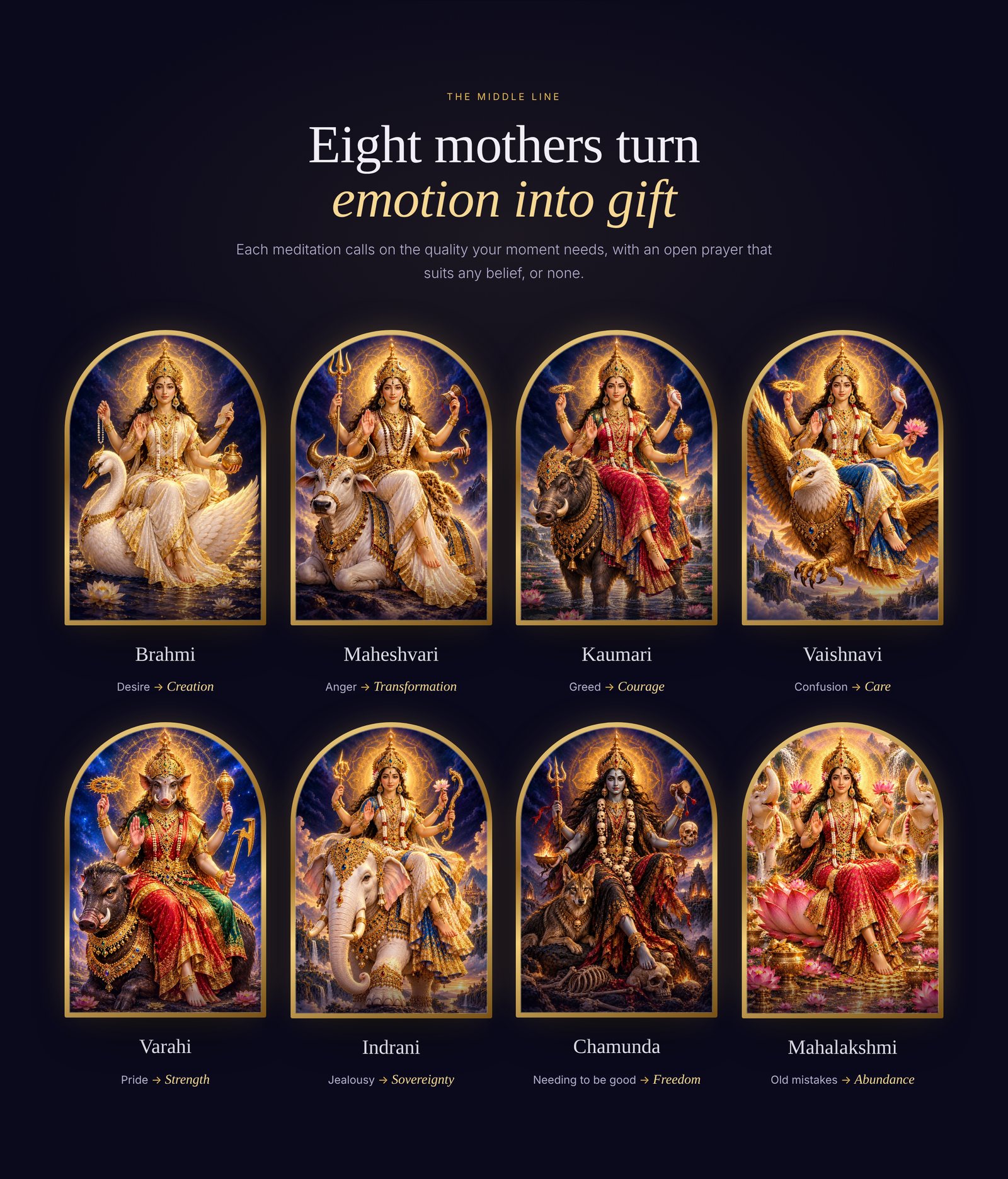
The eight mothers. The middle line holds the eight Matrikas, the mother figures who, in the tradition, turn a raw emotion into a gift. Desire becomes creation. Anger becomes transformation. Greed becomes courage. Each meditation calls on the quality its moment needs.
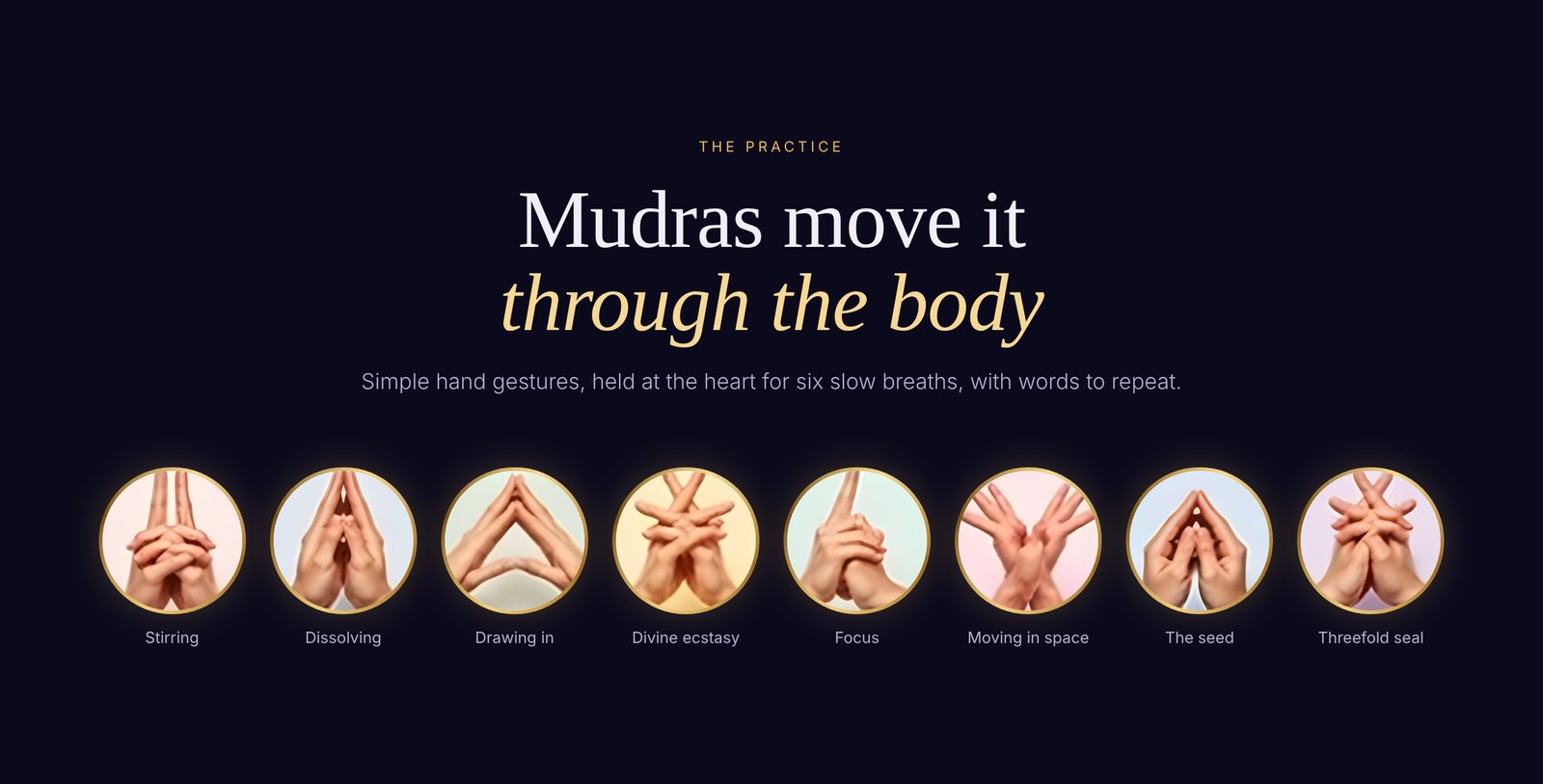
The mudras. The inner line becomes the body. Simple hand gestures from the Sri Yantra tradition are held at the heart for six slow breaths, each with a short phrase to repeat. For many people this is the moment the practice stops being an idea and becomes physical.
The intention is not to present the siddhis as literal supernatural abilities, or the meditation as therapy. It is to use careful design to make a rich, old symbolic system usable in a twelve-minute sitting, for people who have never heard of it as well as for those who have practised with it for years.
Next: music written for the mothers
Today each meditation is carried by a soft, slowly shifting drone. The next chapter is more ambitious.
A group of musicians connected to the project plans to compose original pieces inspired by traditional Tantric chant and by the eight mothers themselves: one musical world for each quality, from Brahmi's creation to Mahalakshmi's abundance. Rather than generic "relaxing" music, each piece is meant to belong to its place in the yantra, so that what you hear changes as you move through it.
Music has always been part of how these traditions travel, from Vedic recitation to devotional singing. The aim is to bring that thread into the app with care for where the chants come from, and to invite musicians and practitioners to help shape it.
For teachers and creators: share something you believe in, and earn from it
If you teach yoga, tantra, breathwork or meditation, or you create for an audience that cares about these traditions, SriYantra.app is built to be easy to recommend.
Why it is easy to share
It costs your audience nothing to try. Everyone's first full meditation is free, with voice, music and their personal reading.
It is personal. People don't get a generic track. They get a meditation about the moment they are carrying, which is why they come back and tell friends.
It respects the tradition. The real structure of the Sri Yantra, explained in plain language, with prayers that suit any belief.
It looks the part. A living 3D yantra, original artwork for every power and every mother. It is beautiful on a phone screen, in a story or a reel.
How the affiliate programme works
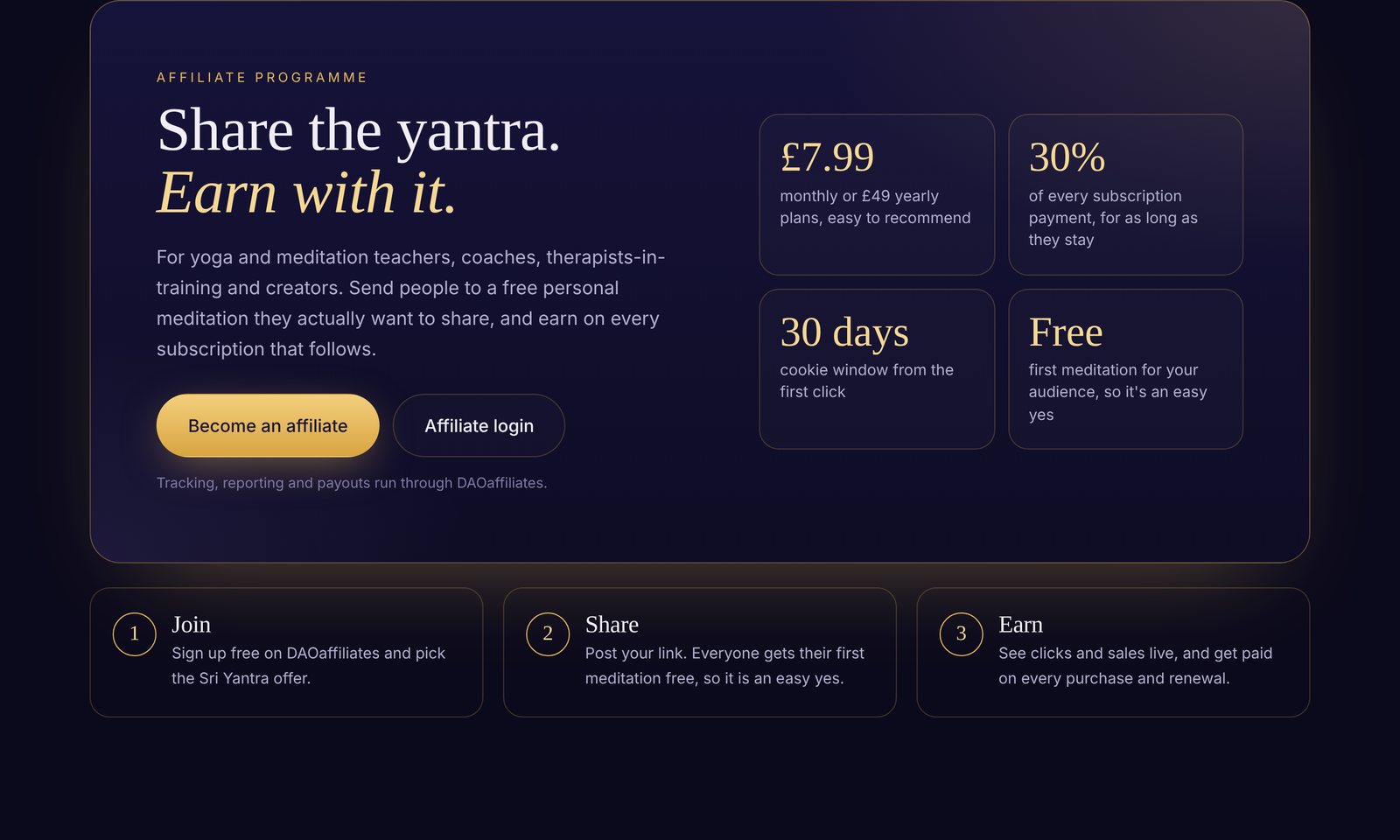
SriYantra.app runs its affiliate programme through DAOaffiliates. You sign up free, pick the Sri Yantra offer and get your own tracking link. Clicks, sign-ups and payouts are reported in your dashboard.
Commission: 30% of every subscription payment, for as long as the person stays subscribed.
Plans your audience can choose: £7.99 a month or £49 a year, after a free first meditation.
What you earn per subscriber: about £2.40 a month (monthly plan) or £14.70 a year (yearly plan).
Cookie window: 30 days from the first click.
Tracking and payouts: DAOaffiliates.
As an illustration only: if 50 people you introduce stay on the monthly plan, that is about £120 a month in recurring commission. Your results will depend on your audience; nothing here is a promise of income.
One practical note: when you share your link, say it is an affiliate link (for example with #ad or "I earn a commission if you subscribe"). It is the honest thing to do and, in the UK and many other countries, it is required.
The invitation goes beyond promotion. Practitioners can help check how traditional ideas are represented, teachers can suggest how to make the practice more meaningful, and musicians can help write its sound.
Help write the next chapter
The Sri Yantra survived a thousand years because people kept carrying it: teachers, artists, musicians, communities. Digital tools can be one more way of carrying it, if they are made with care.
There are three ways to take part.
1. Try it. Think of one moment that is still with you and take your free meditation at sriyantra.app.
2. Share it. Join the affiliate programme at daoaffiliates.com and introduce it to people who will love it.
3. Shape it. Teachers, practitioners and musicians who want to collaborate are warmly invited to get in touch through the site.
SriYantra.app is a meditation and reflection practice, not medical care or therapy. Research on meditation's effects on attention and stress varies widely between techniques, and traditional descriptions should not be read as clinical claims. If you are in crisis, contact your local emergency number or, in the UK and Ireland, Samaritans on 116 123.
*Disclosure: Neurotech.com and SriYantra.app share the same owner.*
Stay wired into neurotech
BCI breakthroughs, funding rounds, and device clearances — weekly, free.